
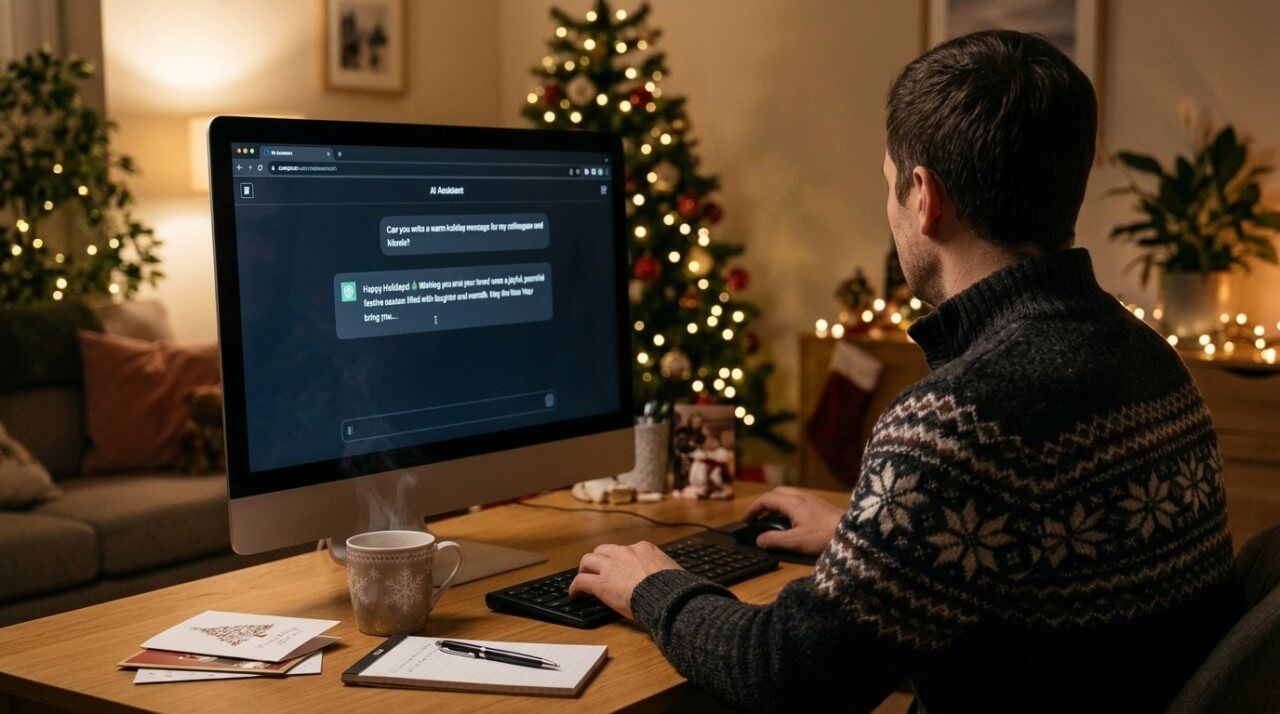
More Than a Third of Americans Planned to Use AI for Holiday Messages. The Last Line Should Still Be Yours
“Dear Megan, may this holiday season bring you endless joy, warmth, and unforgettable moments with your loved ones.”
Perfectly pleasant. Also completely interchangeable. You could send that message to a neighbor, a coworker you’ve barely spoken to, or your own sister. Change the name, and nobody would notice. That’s the problem with letting artificial intelligence write an entire holiday card.
According to a 2025 Refine Packaging survey of 1,000 U.S. adults, 37% planned to use AI tools to help write holiday cards or gift messages. The survey combined those two activities and measured intentions rather than confirmed use. Still, it suggests plenty of Americans were willing to let ChatGPT help with a tradition that has always been rather personal.
We don’t object to AI helping someone who can’t find the right opening sentence. But if you’re sending a holiday card to someone you care about, we’d want at least one sentence that person couldn’t have received from anybody else.
Here are five ways to make that happen.
1. Use the Name You Actually Call Them
AI will happily start your message with “Dear Friend” or “Dear Family.” That’s fine for a company holiday card. Someone you know personally deserves a little more attention.
If you’ve called your sister Megan “Meg” since childhood, write “Dear Meg.” If your closest friend has gone by the same nickname for 20 years, there’s no reason to suddenly address him like a prospective business client.
The Emily Post Institute’s holiday card guide encourages personal greetings and handwritten additions, particularly when sending printed cards. Even a short note can make a standard greeting feel more personal.
Here’s an editing test we recommend: replace the recipient’s name with someone else’s. If the entire card still works, you probably haven’t said anything specific enough.
A message for your sister should sound like it belongs to your sister.
2. Mention One Thing That Actually Happened This Year

AI can make a sentence sound polished. It cannot know which shared memory matters to you unless you provide it.
Consider this familiar line:
“Thank you for all the wonderful memories we created together this year.”
Replace it with something like:
“I still laugh about that afternoon in May when we tried to assemble the grill without instructions. Maybe next summer we’ll actually finish dinner on time.”
That’s an illustrative example, of course. Your own card should contain an event that really happened.
The difference is easy to spot. The first version could appear in 500 cards. The second refers to a particular afternoon that two people remember.
Hallmark’s card-writing advice recommends mentioning a genuine detail, such as a song that reminded you of someone or a recipe they shared.
And it doesn’t have to take long.
Suppose you’re sending 30 holiday cards. Adding one personal sentence to each takes roughly a minute per card. That’s an extra 30 minutes for messages that sound considerably more like you.
We’d consider that time well spent.
3. Tell Them Something They Haven’t Already Seen Online
Holiday cards used to be one of the ways distant relatives learned what happened in each other’s lives during the year.
Now we can see someone’s vacation photos before they’ve even unpacked.
That doesn’t mean your card has nothing new to offer.
Perhaps you’ve changed jobs and are still getting used to your new office. Maybe you’ve finally started the kitchen renovation you’ve talked about for years. A small personal update can give an old friend a reason to write back.
You don’t need to describe every milestone.
The Emily Post Institute’s newsletter advice recommends keeping family updates brief and avoiding excessive self-promotion. One page is plenty for a full newsletter; an ordinary holiday card can get by with a sentence or two.
It’s also worth being careful with the language AI suggests. A new job doesn’t need to become an extraordinary professional journey. You can simply say you’re enjoying the position and miss having lunch with your former coworkers.
That’s the kind of detail someone might genuinely respond to.
4. Check What Kind of Year the Recipient Has Had

Here’s where an automatically generated holiday greeting can become genuinely uncomfortable.
Imagine sending a card to a friend whose father recently died. Your AI-generated message wishes them the happiest year of their life, filled with joyful family celebrations.
The words sound cheerful. For that particular person, they may be painful to read.
A more considerate message might say:
“I’ve been thinking about you this holiday season. I hope you find some peaceful moments, and I’m here if you need anything.”
It’s also worth checking which holidays the recipient celebrates. “Merry Christmas” may be appropriate for one friend, while “Happy Holidays” or “Happy New Year” is better for another.
Emily Post’s guidance specifically recommends broader seasonal greetings when you’re unsure about someone’s religious traditions.
You know your friends’ circumstances better than a chatbot does. Review every message with the actual recipient in mind, especially if they’ve experienced a difficult year.
One further precaution: there’s no need to enter someone else’s private medical information or sensitive family problems into an AI tool. You can request a gentle, supportive tone without disclosing personal details.
5. Sign Your Name and Write the Final Sentence Yourself
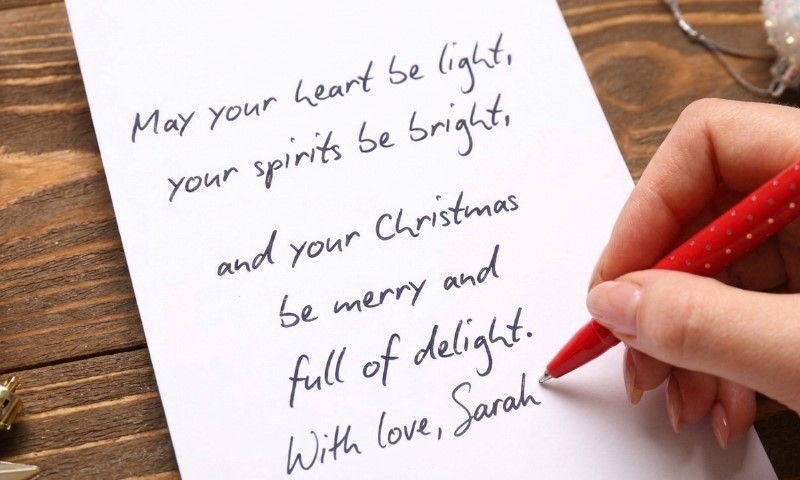
People still appreciate receiving traditional holiday cards.
In a YouGov poll conducted December 11, 2025, among 12,965 U.S. adults, 30% said they loved receiving holiday cards in the mail. Another 30% said they liked them.
That’s 60% with a positive view of a tradition that can seem rather old-fashioned.
The survey didn’t ask respondents to compare handwritten greetings with AI-generated ones, so it doesn’t tell us which they prefer. It does show that physical holiday cards still have a receptive audience.
If you’re sending a printed card, sign it by hand when possible. For an electronic card, make sure the closing sounds like something you’d actually say.
It can be ordinary, even slightly awkward.
“Can’t wait to get coffee again. This time I’m buying.”
Or, for a friend who appreciates a little teasing:
“Tell Jack I still haven’t forgiven him for that poker game.”
Naturally, those lines only work if they reflect a genuine relationship.
You can keep most of an AI-generated draft. Remove expressions you’d never use in conversation, correct anything inaccurate, and write the closing yourself.
A little personality beats another sentence about endless happiness and cherished memories.
Let’s Sum It Up
We don’t think using AI for holiday cards is inherently rude. For someone with dozens of cards to write, a little help with the wording can make the task much more manageable.
The problem begins when every recipient gets essentially the same message with a different name at the top.
Before sending yours, read it once more and ask a simple question: Would this person recognize me in these words?
If the answer is no, add a sentence about something you actually share. It doesn’t need to be clever or particularly emotional.
And if you genuinely can’t think of anything else, there’s always this:
“I miss you. Let’s finally get together next year.”
You probably didn’t need ChatGPT to come up with that one.