Halloween Candy Costs 8.1% More This Year. Here’s What One Piece Really Costs You
The price of Halloween candy deserves a second look this year. A large bag of miniature chocolate bars may seem expensive enough, but the real surprise comes when you calculate the cost per piece. For anyone who expects a steady stream of trick-or-treaters on October 31, those little expenses can add up quickly.
One piece of Halloween candy now costs about 17 cents on average, or $16.96 for 100 pieces. The U.S. Bureau of Labor Statistics recorded an 8.1% annual increase in candy and gum prices in August 2026. The latest September figures, released October 14, show a slightly lower annual increase of 7.7%.
What interests us is how much that increase actually costs a household that hands out candy every Halloween. A few extra cents hardly seem worth discussing when you’re buying one chocolate bar. Multiply that amount by several hundred pieces, and the difference becomes easier to appreciate.
One Piece Costs 17 Cents Today, Compared With 10 Cents Five Years Ago
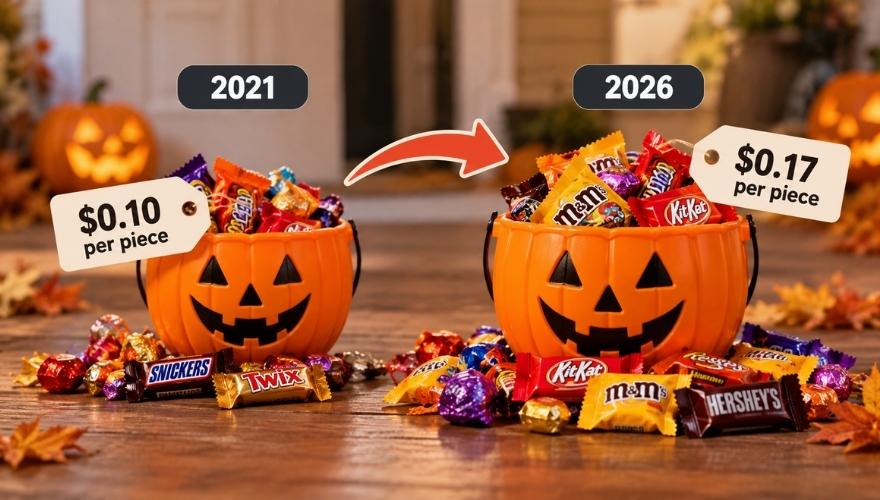
A September 2026 FinanceBuzz study found that the average cost of 100 pieces of Halloween candy increased from $9.91 in 2021 to $16.96 in 2026.
That’s a 71% increase over five years, or an additional $7.05 for the same number of treats.
Researchers examined regular prices at four major retailers, including Walmart and Target. They analyzed at least 25 different candy bags each year, with a minimum of 3,500 individual pieces included in each annual sample. Their average cost per piece rose just 3.5% compared with 2025.
So how can the official inflation figure show an 8.1% increase?
The two measurements cover different products. The Bureau of Labor Statistics tracks the broader candy and chewing gum category. FinanceBuzz examines selected bulk Halloween candy assortments sold at major retailers.
For households that plan to hand out candy, the second calculation provides a useful estimate of what each treat will cost.
How Much Will Halloween Candy Cost for 100 Kids?
Suppose you expect 100 trick-or-treaters and plan to give each child two pieces of candy. You’ll need 200 pieces. At the average price of 16.96 cents each, your total comes to $33.92 before sales tax.
If 150 children visit your home, the same approach will cost $50.88.
Of course, the number of visitors depends on the neighborhood. Some households get through Halloween with one bag of candy. Others need enough treats for several hundred children.
Start with the number of pieces you plan to hand out before deciding which bags to purchase. That calculation gives you a more useful estimate than the total price printed on the largest package.
Watch the video below to learn more about rising Halloween candy costs and how they can affect your holiday budget.
Similar Prices Can Buy Very Different Amounts of Candy
The difference between retailers can be substantial.
Consumer reporter Kristine Lazar compared Halloween candy deals at five major retailers for CBS Los Angeles on October 14, 2026.
Her research included packages with similar prices but different numbers of individual treats.
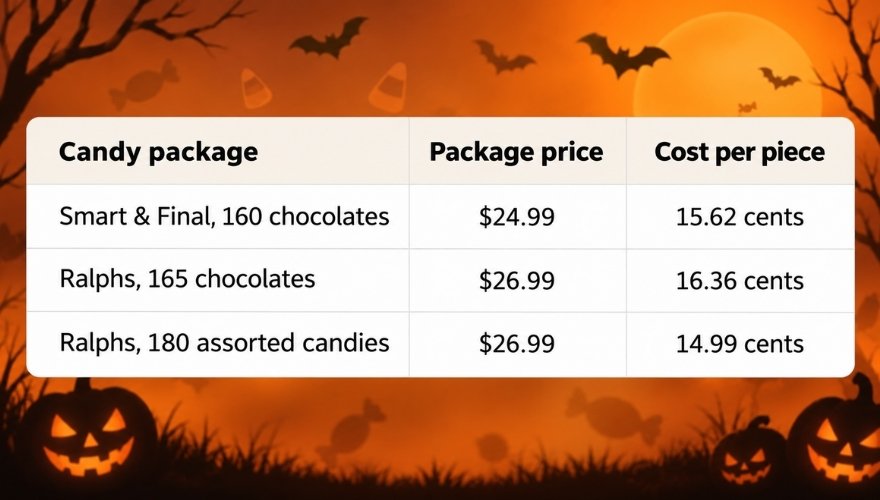
At Ralphs, shoppers could get 15 additional pieces for the same $26.99 by selecting the assorted bag.
There’s another detail worth checking. The piece count tells you how many children you can serve, and the price per ounce reveals how much candy you’re actually purchasing. Miniature chocolates can vary considerably in size, even when their packages appear similar.
For that reason, compare both measurements before choosing the largest bag.
Americans Plan to Spend $4.1 Billion on Halloween Candy
More expensive chocolate bars are already part of Americans’ holiday budgets.
According to the National Retail Federation’s 2026 survey, Americans expect to spend $13.5 billion on Halloween celebrations this year. Candy alone accounts for a projected $4.1 billion.
Among consumers who plan to celebrate, 96% expect to buy candy.
The survey took place September 1 through 9 and included 7,889 U.S. consumers. Average total Halloween expenses are projected to reach $115.14 per person, compared with $114.45 in 2025.
Shoppers are also adjusting how they spend their money. Discount stores are the most popular destination, preferred by 39% of respondents. Nearly half begin their Halloween purchases in September or earlier.
How Much Candy Should You Actually Buy?
For households that welcome trick-or-treaters every year, the advice is fairly straightforward. Estimate how many children usually visit your home, then decide how many pieces you want to give each child.
Check trick-or-treat age limit laws to learn more about age restrictions.
Compare the cost per piece at a few stores before making your purchase. If you have neighbors who also hand out candy, consider splitting a larger package. You may get a better unit price without ending up with more candy than you need.
There’s also a social question worth considering.
Handing out Halloween candy remains a voluntary neighborhood tradition. No established etiquette rule requires homeowners to give every child a particular number of chocolate bars.
Giving each child one good piece of candy and staying within your budget seems perfectly reasonable. Most kids who knock on your door probably have little idea what their chocolate bar cost last year, and they’re unlikely to be interested in a five-year inflation comparison.
They’re there for Halloween. You should be able to enjoy it without spending more than you planned.