How Much to Tip a Tattoo Artist, Touch-Ups Included
Imagine you’ve just finished a tattoo you’ve been planning for months. The artist did an excellent job, you’re happy with the result, and the bill comes to $600. As you reach for your card, another question comes up: Should you add a $120 tip?
In the United States, it’s customary to tip tattoo artists between 15% and 20% of the tattoo price, and some guides recommend as much as 25%. However, tipping is not mandatory.
Our view is that a customer who has already paid several hundred dollars for a professional service shouldn’t feel obligated to give the artist additional money.
Especially since there’s no universal price list for tattoos. One artist charges by the hour, another bases the price on the complexity of the work, and a third sets a price for the entire project. If a customer has agreed to the quoted price, it’s perfectly reasonable to expect that price to already cover quality work.
Why Are You Expected to Tip a Tattoo Artist in the First Place?
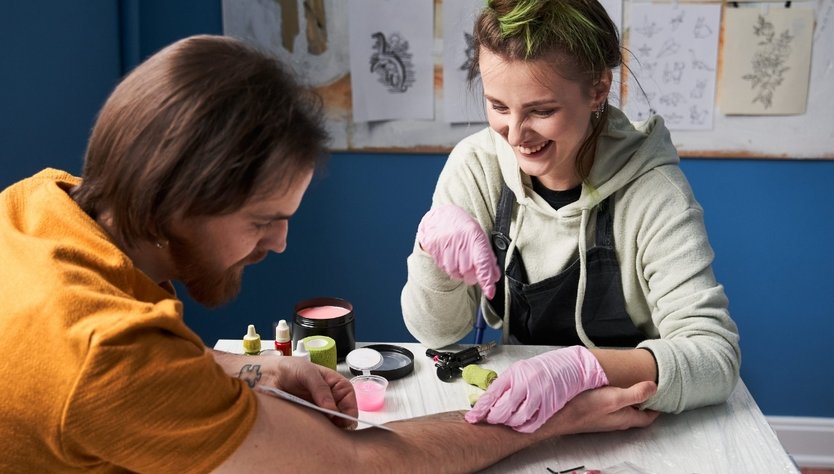
Tattoo artists often have expenses that customers don’t see. They pay rent for their workspace or give a portion of their earnings to the studio. There are also needles, ink, protective equipment, and the time needed to prepare the design.
In Byrdie’s guide, tattoo artist Tyson Weed explains that creating a custom tattoo involves much more work than simply putting ink into the skin.
That’s a perfectly valid argument. However, there’s another side to consider.
The artist sets the price for the service or accepts the studio’s working arrangements. Customers have no insight into the artist’s business expenses and shouldn’t be responsible for covering them with additional money.
Interestingly, some professionals agree with that approach. Chicago-based Logan Square Tattoo openly states that it charges a fair price for its work and appreciates tips but doesn’t expect them.
Still wondering whether tipping your tattoo artist is expected or simply a personal choice? In the following video, tattoo artist James Withee shares his perspective on tipping etiquette, helping explain what’s customary and why a tip doesn’t have to be automatic.
Should You Tip for a Free Tattoo Touch-Up?
Let’s say you paid $400 for a tattoo. After it heals, you notice that a small area of ink has faded. Your artist invites you back for a free touch-up.
Should you now leave a $20 or $30 tip?
According to Byrdie’s recommendations, tipping is appreciated even when a touch-up is free because the artist is once again spending time and using supplies.
We see it differently. If the touch-up is part of the original agreement, there’s no reason for the customer to pay extra. Especially if the touch-up is needed to correct an issue with the original work.
Of course, if the artist spends additional time at no charge on something that wasn’t part of the agreement, $10 or $20 can be a nice gesture.
The situation changes when the touch-up is charged separately. In that case, there’s already a new price for new work. Anyone who wants to leave an additional 15% or 20% can do so, but there’s no reason to feel impolite for paying only the agreed amount.
Before you book, be sure to ask if the first touch-up is free, how long that offer remains valid, and what conditions apply.
What If a Large Tattoo Takes Several Sessions?
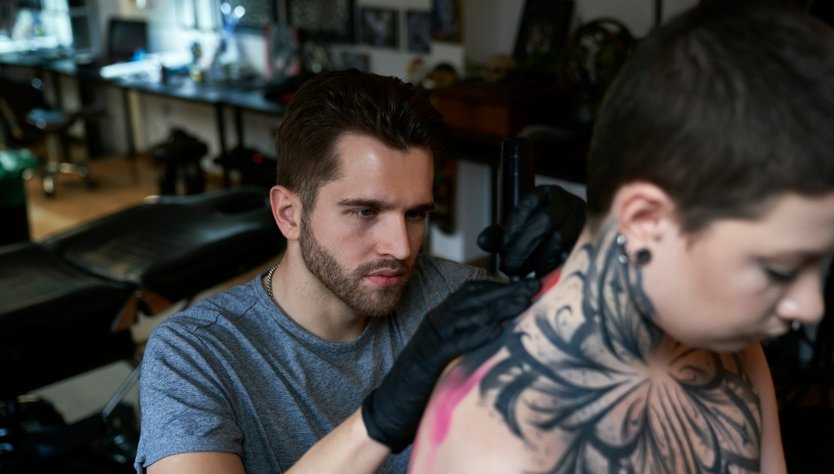
Large back tattoos or full sleeves can require multiple appointments. According to Logan Square Tattoo, customers who tip typically do so after each session.
But consider the math.
Five sessions at $400 each bring the total to $2,000. With a 20% tip after every appointment, the customer ends up paying an additional $400.
To us, that’s too much to present as a normal social obligation.
It’s far more reasonable to agree on a price for the entire project, check what’s included, and leave any additional gratuity based on personal satisfaction and budget.
Paying for a Tattoo Already Shows That You Value Someone’s Work
Tipping has become so widespread in America that customers are increasingly asked to pay extra even for services with a predetermined price. We’ve already written about situations where it’s perfectly polite to skip the tip.
Tattoo artists deserve respect and fair compensation. We don’t question that.
But there are other ways to show respect. A satisfied customer can leave an honest positive review, recommend the artist to friends, or book another appointment.
Ultimately, if a tattoo costs $800, it’s perfectly acceptable to pay $800. In American tipping culture, someone may expect more, but an expectation is not the same as an obligation.
A good tip is a voluntary expression of gratitude. The moment it becomes expected, it stops being a gift and becomes another charge on the bill.